

Women worry that breast screening could be painful or embarrassing
Breast screening saves lives. Through early diagnosis, it improves health outcomes and lowers health inequalities.
Southend council appointed Social Engine to develop a research programme that would explore why their local rates of breast screening remained stubbornly low and to make recommendations for improving uptake.


Client
Southend on Sea City Council
The brief
Develop a research programme to explore why some women don’t go to breast screening and make recommendations for increasing uptake.
Key insight
Most women have positive views about breast screening, but the majority who don’t attend say they never got a reminder to do so, suggesting that more frequent reminders and in-person referrals by professionals can help drive uptake.

Breast screening evokes strong emotions. Worries about breast cancer, negative experiences of friends and family, and issues around menopause and ageing, all make breast screening a topic that many women would prefer to ignore.
We knew that if we were going to help improve the health of women in Southend-on-Sea, we needed to get under the skin of the issues – understanding what women do, or don’t do, as well as their daily lives, their ambitions, their motivations, and any external factors that might influence decision making.
It was important to engage directly with local women. Social Engine designed a research approach that was underpinned by behavioural insights using mixed methods, including desk review, a survey and in-depth interviews.
Our research team collected data on a range of factors, including levels of awareness, perceptions of the service, motivations and opportunities for engagement.
We invited people to take part via a Facebook advert and through official council channels.
What we discovered
Most women in our study had positive views about breast screening. They saw it as normal and part of a commonsense routine. They believed the benefits of screening outweighed the costs of discomfort and embarrassment.
The key driver for most women who do attend? Their peers do the same. For these women, going to breast screening had become a powerful social norm, suggesting that positive peer narratives are one of the most powerful ways to influence behaviour.
‘I remember being quite nervous getting the invitation. People tell you horror stories about how uncomfortable and painful it is.’
‘
Why some women don't go
The two key concerns of women who didn’t attend screening were: fear about removing their clothes and worry that the process might hurt.
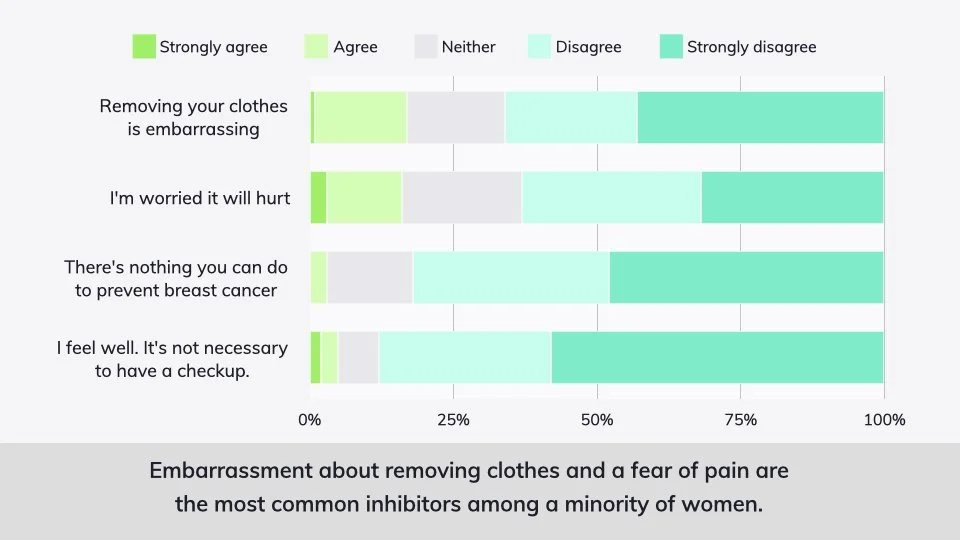
But the most important factor, by far, was a perceived lack of notifications or reminders. A full 72% of women who didn’t attend breast screening said they had not been recommended to do so by a healthcare provider.
2X
Women who knew someone who had been to screening were twice as likely to go as women who didn’t.
as likely
72%
of women who didn’t go to breast screening said it was because they hadn’t been recommended to do so by a healthcare provider.
Key facts
Life expectancy varies dramatically by 9.4 years between women in the least and most deprived areas in Southend.
Uptake of screening is particularly low among women from minoritised and low socio-economic backgrounds, as well as among ‘first timers’ who are aged 50-53.
Conclusions
Many had very low recall of previous messaging or reminders, suggesting campaigns should be more vivid as well as more frequent.
‘First timers’ have relatively low awareness of what happens in a screening consultation, leaving room for fears and ‘horror stories’. They need more detail, along with reassurance for their concerns about pain and embarrassment.
Positive peer conversations establish positive social norms - one of the key drivers to uptake.
Recommendations
Encourage women to ‘tell a friend’ when they have been to breast screening. Positive peer narratives from trusted messengers are a key driver.
Build awareness by engaging women early on, before they receive their first invitation.
Demystify the process and provide more detail, reassuring women that any discomfort is minimal and their privacy will be respected.
My friends told me to do it and not skip it, even though I was worried.’